A Toronto police officer with four years' service has been charged with sexual assault.
Const. Richard Akunyili, 35, is alleged to have sexually assaulted a female victim at her home Wednesday. The officer was off-duty at the time, police said.
Akunyili works in the Toronto Police Service's 52 Division, which covers a central downtown area south of Bloor Street.
Akunyili, who was arrested and charged Thursday, is due to make a court appearance Monday.
CBC.CA

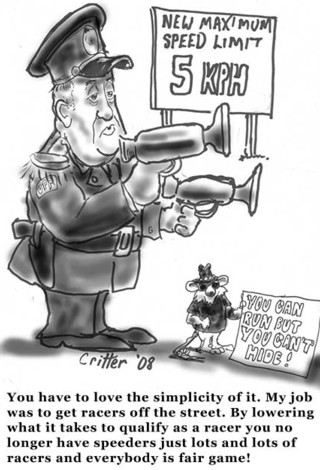
critter cartoon
Friday, September 25, 2009

Police officer cleared in crash that killed colleague.
September 25, 2009
Canadian Press
LONDON, Ont. — Ontario’s police watchdog has cleared a provincial police officer of any criminal wrongdoing in a crash that killed her colleague.
On July 6, Const. Alan Hack died when the cruiser in which he was a passenger collided with a tractor-trailer in Elgin County.
The Special Investigations Unit says the driver, Const. Lynn Neale, drove through a stop sign moments before the crash.
The SIU says it appears Neale never saw the truck until the last moment due to her focus on a suspect trying to elude police.
The agency adds that Neale did nothing a “reasonable person” in a similar situation wouldn’t have.
Hack, who was 31, was in the back seat and neither he nor Neale was wearing a seatbelt. Both were thrown from the cruiser.
The Spec
Canadian Press
LONDON, Ont. — Ontario’s police watchdog has cleared a provincial police officer of any criminal wrongdoing in a crash that killed her colleague.
On July 6, Const. Alan Hack died when the cruiser in which he was a passenger collided with a tractor-trailer in Elgin County.
The Special Investigations Unit says the driver, Const. Lynn Neale, drove through a stop sign moments before the crash.
The SIU says it appears Neale never saw the truck until the last moment due to her focus on a suspect trying to elude police.
The agency adds that Neale did nothing a “reasonable person” in a similar situation wouldn’t have.
Hack, who was 31, was in the back seat and neither he nor Neale was wearing a seatbelt. Both were thrown from the cruiser.
The Spec
What?
 Sharon Bamford photo
No Spin and from The Toronto Sun, props for Connie Woodcock
I wonder what Fantino's fan club at the Sun thinks of this article?
Ontario Provincial Police Commissioner Julian Fantino is well known for taking his religion seriously.
I realize that makes a lot of people nervous in our secular society but as an active Anglican myself, I rather like it. Surely it's a good thing that the most influential police officer in Ontario is a happy warrior when it comes to the major Christian prohibitions -- no killing, for example, and no stealing. What can be wrong with that?
But a couple of weeks ago, he said something that bothered me to no end.
He was commenting on the decision of an Ontario judge that struck down a particularly contentious section of the law against stunt driving that allows police to seize a speeder's vehicle and licence immediately -- before the driver has been found guilty in court.
The judge found the seizures to be unconstitutional since the Charter of Rights and Freedoms guarantees a person is considered innocent until proven guilty.
UNDER APPEAL
But the OPP are going to continue seizing vehicles while the decision is under appeal and Fantino justified it by calling it "the Lord's work."
"When you look at the carnage that we're experiencing on our highways, the kinds of injuries we're having to deal with, the extraordinary health costs, the loss of productivity, the loss of a loved one, all of which is preventable, and you look at speed being a causal factor," he told a Sun Media reporter. "I think we're doing the Lord's work, personally. And we'll continue doing it."
Seizing vehicles is the Lord's work?
Oh really? Funny, but I don't recall the Almighty making any references whatever to "stunt driving" and I wasn't aware He got involved in constitutional matters, although I'm pretty sure that "thou shalt not steal" is up fairly high on His list of priorities.
And seizing the car of someone who has not been proven guilty seems a lot like stealing to me.
The particular case involved an Ontario grandmother who was caught doing 51 km/h over the limit. The stunt driving law kicks in at 50. She says stunt driving was about the farthest thing from her mind. She was just trying to get past a big truck as quickly as she could and who among us hasn't done that?
Professional drivers will tell you that you really don't want to be in the trucker's blind spot any longer than necessary.
There's a big difference between a woman passing a truck quickly and a bunch of kids in hot cars out street racing, but the law doesn't allow for differentiation. When you cross the 50 km/h threshold, you're done and the fine ranges up to $10,000.
The law has been called everything from ridiculous to odious and to hear the OPP commissioner say enforcing it is doing the Lord's work is offensive.
I wonder what he calls that other ridiculous and odious practice that allows Ontario cops to seize a vehicle when the driver blows .05 on a breathalyzer test even though the law draws the line on impairment at .08?
Now I don't like Bible "proofers" -- those objectionable people who are forever quoting scripture to prove whatever they want. But this time, I can't resist.
So here are a few words for the commissioner straight from the horse's mouth. "Blessed are those who show mercy; mercy shall be shown to them."
And better yet, "Blessed are those who are persecuted in the cause of right; the kingdom of heaven is theirs."
So no, I don't think Fantino is doing the Lord's work on this one. Maybe that other guy's, though...
CONNIE.WOODCOCK@SUNMEDIA.CA
The Toronto Sun
Saturday, September 19, 2009
Saying what needs saying!
Ontario has added one more journalist to a very very very small group, who will actually report a story the way it is!
Bryant and bike courier a class issue
Sep 18, 2009 04:30 AM
Antonia Zerbisias
"A journalist's job is to comfort the afflicted and afflict the comfortable."
Attributed to American critic H.L. Mencken (1880-1956)
On Sept. 1, after former Ontario attorney-general Michael Bryant was charged with "criminal negligence causing death" and "dangerous operation of a motor vehicle causing death," there wasn't much comforting the afflicted.
Anyway, bicycle courier Darcy Allan Sheppard was more than afflicted.
He had been left bleeding from his nose and mouth on Bloor St., only to die in hospital after allegedly being bashed against a mailbox while hanging on to Bryant's convertible.
These are the claims that Toronto has learned from witnesses, police and media reports.
There is no dispute that, not only did Bryant engage one of the best criminal lawyers money could buy, he lined up a top-tier communications firm called Navigator to handle his public representations and, as the Star reported, shopped for a private investigator to dig up evidence.
It's very difficult not to remark on the unfair physical match between a cyclist and a motorist.
It's also tough not to notice the imbalance between a once-promising politician and the unfortunate product of just about the very worst sequence of disadvantages any Canadian can be born into.
So yes, this is very much a class issue.
Since that tragic late summer evening which has divided this city – cyclist v. motorist, rich v. poor, right v. left, pitbull lover v. Bryant's hated legislation – there's been much ink spilled on whether Sheppard was drunk, whether he grabbed Bryant's wheel, whether he slammed his backpack on the hood, as well as his past.
Just this week in Maclean's, for example, there is no sympathy spared for the victim.
But, as former Olympic cyclist and cycling lawyer Bob Mionske outlines on Bicycling.com, it's all spin.
"Why do I think it's spin?" he asks. "Because details about Sheppard's ancient run-ins with the law over stolen cheques had nothing to do with what happened the night of his death. Neither did stories about noise complaints from neighbours, or his problems with alcohol ... But they had everything to do with shaping public opinion, turning the public against Sheppard, and in support of Bryant."
That's why you can't help but get the impression that some people are more equal than others.
Except that now, Twitter and YouTube have brought yet another perspective. Which brings us to @BryantTruths and HonestEdits.
HonestEdits, who has been posting surveillance videos from the scene on YouTube, prefers to remain anonymous. HonestEdits' videos, compressed for clarity, string together two clips in a chronological sequence that the corporate media have not presented.
True, they're not exactly high-definition. (Try an iPhone.) And they may not tell the whole story. In fact, last week, when the first video popped up, the Bryant camp, via its blog, denounced its narration as "inaccurate and one-sided."
Now that post is gone – but I have screen grabs.
Interestingly, what's not gone is the video, plus others since added, now viewed some 40,000 times, collectively, and on various blogs.
PR pro and and cycling advocate Don Wiedman is @BryantTruths, tweeting what he calls "the other side of the story."
He does it because he feels that the PR profession is getting a bad name – and also because he has found himself in street face-offs with "guys in their 40s in big black cars."
As he told me, "I want a better world. I want to fight for the underdog."
Which is what journalism should be about.
Meanwhile, the Navigator-produced bryantfacts.wordpress.com and tweets (@BryantFacts) have scaled back – with the former now containing only a terse announcement that it "will be used for the release of any official statements."
Bryant will have his day in court next month – and, presumably, a trial will eventually follow.
As both Weidman and Honest-Edits tell me, Sheppard may be dead – he won't be silenced.
Antonia Zerbisias is a Living section columnist. azerbisias@thestar.ca. She blogs at thestar.blogs.com.
Toronto Star
Bryant and bike courier a class issue
Sep 18, 2009 04:30 AM
Antonia Zerbisias
"A journalist's job is to comfort the afflicted and afflict the comfortable."
Attributed to American critic H.L. Mencken (1880-1956)
On Sept. 1, after former Ontario attorney-general Michael Bryant was charged with "criminal negligence causing death" and "dangerous operation of a motor vehicle causing death," there wasn't much comforting the afflicted.
Anyway, bicycle courier Darcy Allan Sheppard was more than afflicted.
He had been left bleeding from his nose and mouth on Bloor St., only to die in hospital after allegedly being bashed against a mailbox while hanging on to Bryant's convertible.
These are the claims that Toronto has learned from witnesses, police and media reports.
There is no dispute that, not only did Bryant engage one of the best criminal lawyers money could buy, he lined up a top-tier communications firm called Navigator to handle his public representations and, as the Star reported, shopped for a private investigator to dig up evidence.
It's very difficult not to remark on the unfair physical match between a cyclist and a motorist.
It's also tough not to notice the imbalance between a once-promising politician and the unfortunate product of just about the very worst sequence of disadvantages any Canadian can be born into.
So yes, this is very much a class issue.
Since that tragic late summer evening which has divided this city – cyclist v. motorist, rich v. poor, right v. left, pitbull lover v. Bryant's hated legislation – there's been much ink spilled on whether Sheppard was drunk, whether he grabbed Bryant's wheel, whether he slammed his backpack on the hood, as well as his past.
Just this week in Maclean's, for example, there is no sympathy spared for the victim.
But, as former Olympic cyclist and cycling lawyer Bob Mionske outlines on Bicycling.com, it's all spin.
"Why do I think it's spin?" he asks. "Because details about Sheppard's ancient run-ins with the law over stolen cheques had nothing to do with what happened the night of his death. Neither did stories about noise complaints from neighbours, or his problems with alcohol ... But they had everything to do with shaping public opinion, turning the public against Sheppard, and in support of Bryant."
That's why you can't help but get the impression that some people are more equal than others.
Except that now, Twitter and YouTube have brought yet another perspective. Which brings us to @BryantTruths and HonestEdits.
HonestEdits, who has been posting surveillance videos from the scene on YouTube, prefers to remain anonymous. HonestEdits' videos, compressed for clarity, string together two clips in a chronological sequence that the corporate media have not presented.
True, they're not exactly high-definition. (Try an iPhone.) And they may not tell the whole story. In fact, last week, when the first video popped up, the Bryant camp, via its blog, denounced its narration as "inaccurate and one-sided."
Now that post is gone – but I have screen grabs.
Interestingly, what's not gone is the video, plus others since added, now viewed some 40,000 times, collectively, and on various blogs.
PR pro and and cycling advocate Don Wiedman is @BryantTruths, tweeting what he calls "the other side of the story."
He does it because he feels that the PR profession is getting a bad name – and also because he has found himself in street face-offs with "guys in their 40s in big black cars."
As he told me, "I want a better world. I want to fight for the underdog."
Which is what journalism should be about.
Meanwhile, the Navigator-produced bryantfacts.wordpress.com and tweets (@BryantFacts) have scaled back – with the former now containing only a terse announcement that it "will be used for the release of any official statements."
Bryant will have his day in court next month – and, presumably, a trial will eventually follow.
As both Weidman and Honest-Edits tell me, Sheppard may be dead – he won't be silenced.
Antonia Zerbisias is a Living section columnist. azerbisias@thestar.ca. She blogs at thestar.blogs.com.
Toronto Star
Tuesday, September 15, 2009
McGuinty accused of misleading public
Karen Howlett
Toronto — From Tuesday's Globe and Mail
Last updated on Tuesday, Sep. 15, 2009 02:59AM EDT
.The Ontario Legislature's fall session began yesterday with the opposition formally accusing Premier Dalton McGuinty of misleading the public over a provincial agency embroiled in a spending scandal.
Progressive Conservative Leader Tim Hudak set the tone during Question Period by asking the Premier about his “summer of scandal.” It was Mr. Hudak's first opportunity to confront Mr. McGuinty face-to-face in the legislature since he became leader in June.
The Conservatives have kept the Premier on the defensive all summer over lavish spending at two provincial agencies, and government officials were bracing for a fresh round of revelations from the opposition when the legislature returned.
“I just kept waiting and waiting,” a government source said yesterday.
But Mr. Hudak confined his attacks to scandal-plagued eHealth Ontario and statements made by Mr. McGuinty that, Mr. Hudak says, are “demonstrably false.”
The Tories and New Democrats together lodged a formal complaint with the Speaker's Office, accusing the Premier and Health Minister David Caplan of deliberately misleading the legislature about a review of eHealth.
The matter dates back to early June, when Mr. McGuinty said accounting firm PricewaterhouseCoopers had been retained to conduct an independent review of lucrative contracts the agency had awarded to consultants without competitive tenders.
But there never was a contract in place to retain the accounting firm, Mr. Hudak said.
“He misled Ontarians,” he said. “It is clear that Ontarians cannot trust him to fix the culture of entitlement that he himself created.”
Mr. McGuinty said during Question Period that the Pricewaterhouse review was called off because the provincial auditor was already conducting his own review of eHealth.
“It was certainly my understanding that PWC had been retained,” Mr. McGuinty said. “There is no nefarious plot afoot, as my friend may intimate.
The government has been under siege over eHealth since last May, when the Tories obtained documents through a freedom-of-information request, showing that the agency awarded sole-sourced contracts to consultants, many of whom submitted nickel-and-dime expense claims. The revelations led to the resignations of CEO Sarah Kramer and chairman Alan Hudson in June.
The Premier's Office released several letters, showing that Mr. Caplan had, in fact, asked Dr. Hudson to undertake an immediate third-party review of eHealth's management practices.
“I am troubled by inadequate reassurances following reports about eHealth Ontario's spending practices,” Mr. Caplan says in the letter, dated June 1.
But the audit was called off after Auditor-General Jim McCarter wrote to Rita Burak, Dr. Hudson's successor, on June 29, saying that having Pricewaterhouse do a review would amount to a potential duplication of his work.
Mr. McGuinty has taken steps to rein in agencies that operate at arm's length from the government, after spending scandals at eHealth and the Ontario Lottery and Gaming Corp. The government fired the lottery corporation's CEO, Kelly McDougald, with cause, and the entire board resigned amid revelations of wining and dining by employees. Ms. McDougald has launched a lawsuit against the government.
Yesterday, the government announced that senior executives at 21 of the province's largest agencies will be required to publish their spending on travel and entertainment online, beginning no later than April 1.
“We're going to shine a light on expenses so Ontarians will know who exactly is spending what exactly,” Mr. McGuinty told reporters.
Globe and Mail
Toronto — From Tuesday's Globe and Mail
Last updated on Tuesday, Sep. 15, 2009 02:59AM EDT
.The Ontario Legislature's fall session began yesterday with the opposition formally accusing Premier Dalton McGuinty of misleading the public over a provincial agency embroiled in a spending scandal.
Progressive Conservative Leader Tim Hudak set the tone during Question Period by asking the Premier about his “summer of scandal.” It was Mr. Hudak's first opportunity to confront Mr. McGuinty face-to-face in the legislature since he became leader in June.
The Conservatives have kept the Premier on the defensive all summer over lavish spending at two provincial agencies, and government officials were bracing for a fresh round of revelations from the opposition when the legislature returned.
“I just kept waiting and waiting,” a government source said yesterday.
But Mr. Hudak confined his attacks to scandal-plagued eHealth Ontario and statements made by Mr. McGuinty that, Mr. Hudak says, are “demonstrably false.”
The Tories and New Democrats together lodged a formal complaint with the Speaker's Office, accusing the Premier and Health Minister David Caplan of deliberately misleading the legislature about a review of eHealth.
The matter dates back to early June, when Mr. McGuinty said accounting firm PricewaterhouseCoopers had been retained to conduct an independent review of lucrative contracts the agency had awarded to consultants without competitive tenders.
But there never was a contract in place to retain the accounting firm, Mr. Hudak said.
“He misled Ontarians,” he said. “It is clear that Ontarians cannot trust him to fix the culture of entitlement that he himself created.”
Mr. McGuinty said during Question Period that the Pricewaterhouse review was called off because the provincial auditor was already conducting his own review of eHealth.
“It was certainly my understanding that PWC had been retained,” Mr. McGuinty said. “There is no nefarious plot afoot, as my friend may intimate.
The government has been under siege over eHealth since last May, when the Tories obtained documents through a freedom-of-information request, showing that the agency awarded sole-sourced contracts to consultants, many of whom submitted nickel-and-dime expense claims. The revelations led to the resignations of CEO Sarah Kramer and chairman Alan Hudson in June.
The Premier's Office released several letters, showing that Mr. Caplan had, in fact, asked Dr. Hudson to undertake an immediate third-party review of eHealth's management practices.
“I am troubled by inadequate reassurances following reports about eHealth Ontario's spending practices,” Mr. Caplan says in the letter, dated June 1.
But the audit was called off after Auditor-General Jim McCarter wrote to Rita Burak, Dr. Hudson's successor, on June 29, saying that having Pricewaterhouse do a review would amount to a potential duplication of his work.
Mr. McGuinty has taken steps to rein in agencies that operate at arm's length from the government, after spending scandals at eHealth and the Ontario Lottery and Gaming Corp. The government fired the lottery corporation's CEO, Kelly McDougald, with cause, and the entire board resigned amid revelations of wining and dining by employees. Ms. McDougald has launched a lawsuit against the government.
Yesterday, the government announced that senior executives at 21 of the province's largest agencies will be required to publish their spending on travel and entertainment online, beginning no later than April 1.
“We're going to shine a light on expenses so Ontarians will know who exactly is spending what exactly,” Mr. McGuinty told reporters.
Globe and Mail
Sunday, September 13, 2009
National Post editorial board: The beginning of the end for a stupid law
Posted: September 11, 2009, 8:30 AM by NP Editor
Edirorial
So the Attorney-General of Ontario says he believes -- contrary to an opinion handed down last week by Ontario Court Justice Geoffrey Griffin -- that the province's stunt-driving law is wholly constitutional, and will be upheld on an appeal he intends to make. Well, perhaps it is all for the best that appellate courts will quickly get to review, and trample, the odious provision that makes exceeding the posted speed limit by 50 km/h an "absolute liability" offence that effectively allows for no defence by the accused. Judge Griffin's ruling is only binding on justices of the peace; by taking the matter to a higher court, Attorney-General Bentley is risking a more permanent, unconditional and thorough reversal.
One says "risking," but the outcome is as certain as any such matter could imaginably be. The absolute liability provision in the stunt-driving law could not be more obvious or ostentatious in its unconstitutionality. The Charter of Rights says that an accused person is "to be presumed innocent until proven guilty," but the norms underlying the notion of proof of guilt are much older -- in a way, more deeply entrenched in our common understanding of the law and our relations with the state. Since time immemorial, prosecutors seeking to convict on an offence have had to meet a dual test; that the illegal act or omission actually happened and that the accused intended to do wrong, or was somehow careless or negligent. In short, that they possessed mens rea. It's in Latin, which is a useful hint at how old the concept is.
The law dismisses the requirement to prove intent when it comes to lighter penalties such as the loss of driving privileges, but it is platinum-clad Canadian law, established in the B.C. Motor Vehicle Reference of 1985, that absolute liability cannot lead to a risk of imprisonment, or indeed to any penalty that impinges upon the "life, liberty and security of the person." The attorney-general who created the stunt-driving law ought to have known that it would collapse the first time it was challenged -- indeed, that no judge who was aware of Charter jurisprudence would have any other choice. But Michael Bryant is, understandably, too busy with personal matters at the moment to offer an explanation of why he wasted the time and effort of Ontario courts framing and debating legislation that was patently unconstitutional.
Mr. Bryant is an easy target here, but one notices that the case which led to Judge Griffin's ruling exhibits signs of a sickening failure of human sympathy and social reasoning on the part of police and prosecutors. Jane Raham was caught just one km/h over the stunt-driving limit while trying to pass a truck on Highway 7 near Kaladar, Ont. She could have based a defence on the inherent inaccuracy of a measurement of her speed taken from a moving police car; instead, she and her lawyers --pardon the metaphor -- took the high road, acting for the benefit of all citizens.
As Justice Griffin observed, Ms. Raham is not, in any ordinary sense of the word, a "stunt driver"; she is a grandmother who didn't want to stay in the blind spot of a truck, or in the passing lane of a highway, any longer than necessary. This seems not only natural, but indicative of a positive, sensible road awareness and concern for safety (not to mention a willingness to step on the gas that is quite laudable in an older person).
But inexplicably, nobody decided to give her the benefit of the doubt and revise the stunting ticket before this matter even reached a courtroom. Why not? Are Ontario's police nothing but unthinking automatons determined to see the law upheld at any cost in human suffering and fear? We certainly hope not -- and think not in most cases. But the danger that some of them might be is one more reason the law should not stand in its current form.
National Post
Edirorial
So the Attorney-General of Ontario says he believes -- contrary to an opinion handed down last week by Ontario Court Justice Geoffrey Griffin -- that the province's stunt-driving law is wholly constitutional, and will be upheld on an appeal he intends to make. Well, perhaps it is all for the best that appellate courts will quickly get to review, and trample, the odious provision that makes exceeding the posted speed limit by 50 km/h an "absolute liability" offence that effectively allows for no defence by the accused. Judge Griffin's ruling is only binding on justices of the peace; by taking the matter to a higher court, Attorney-General Bentley is risking a more permanent, unconditional and thorough reversal.
One says "risking," but the outcome is as certain as any such matter could imaginably be. The absolute liability provision in the stunt-driving law could not be more obvious or ostentatious in its unconstitutionality. The Charter of Rights says that an accused person is "to be presumed innocent until proven guilty," but the norms underlying the notion of proof of guilt are much older -- in a way, more deeply entrenched in our common understanding of the law and our relations with the state. Since time immemorial, prosecutors seeking to convict on an offence have had to meet a dual test; that the illegal act or omission actually happened and that the accused intended to do wrong, or was somehow careless or negligent. In short, that they possessed mens rea. It's in Latin, which is a useful hint at how old the concept is.
The law dismisses the requirement to prove intent when it comes to lighter penalties such as the loss of driving privileges, but it is platinum-clad Canadian law, established in the B.C. Motor Vehicle Reference of 1985, that absolute liability cannot lead to a risk of imprisonment, or indeed to any penalty that impinges upon the "life, liberty and security of the person." The attorney-general who created the stunt-driving law ought to have known that it would collapse the first time it was challenged -- indeed, that no judge who was aware of Charter jurisprudence would have any other choice. But Michael Bryant is, understandably, too busy with personal matters at the moment to offer an explanation of why he wasted the time and effort of Ontario courts framing and debating legislation that was patently unconstitutional.
Mr. Bryant is an easy target here, but one notices that the case which led to Judge Griffin's ruling exhibits signs of a sickening failure of human sympathy and social reasoning on the part of police and prosecutors. Jane Raham was caught just one km/h over the stunt-driving limit while trying to pass a truck on Highway 7 near Kaladar, Ont. She could have based a defence on the inherent inaccuracy of a measurement of her speed taken from a moving police car; instead, she and her lawyers --pardon the metaphor -- took the high road, acting for the benefit of all citizens.
As Justice Griffin observed, Ms. Raham is not, in any ordinary sense of the word, a "stunt driver"; she is a grandmother who didn't want to stay in the blind spot of a truck, or in the passing lane of a highway, any longer than necessary. This seems not only natural, but indicative of a positive, sensible road awareness and concern for safety (not to mention a willingness to step on the gas that is quite laudable in an older person).
But inexplicably, nobody decided to give her the benefit of the doubt and revise the stunting ticket before this matter even reached a courtroom. Why not? Are Ontario's police nothing but unthinking automatons determined to see the law upheld at any cost in human suffering and fear? We certainly hope not -- and think not in most cases. But the danger that some of them might be is one more reason the law should not stand in its current form.
National Post
Julian Fantino: Business as usual!

I love what "Mr Accountabilty" calls it!
This is same Comissioner who's on his second adjudicator and the THIRD appeal to have the second adjudicator tossed in the internal hearing up in Orillia..........That's hysterical nonsense
Hat's off to you Mr. Clarkson for asking some decent questions.
Judge declares part of stunt-driving legislation unconstitutional but law will still be enforced, OPP Commissioner says
By BRETT CLARKSON, SUN MEDIA
OPP Commissioner Julian Fantino calls it "the Lord's work."
He said his officers will "make no apologies" for continuing to enforce a law that gives police the power to impound vehicles, suspend licences, and slap high fines against drivers before the driver has a chance to appear in court.
After a Napanee judge ruled a section of the provincial anti-stunt driving law to be unconstitutional, Fantino defended the legislation as the "greater good" and said police shouldn't be regarded as the "bad guys" for trying to save dangerous drivers from themselves and others.
"We're saving lives," Fantino said. "The people who need to get their act together are those who are driving aggressively, who are driving dangerously, who in this case are driving in excess of 50 km/h over the posted speed limit. They're the ones who are the problem, we're not it.
"We're just trying to save them from being killed and killing other people," Fantino said.
Fantino's comments came after Justice Geoffrey Griffin ruled in a Napanee courthouse on Friday that a section of the province's stunt-driving legislation is unconstitutional.
Jane Raham, 62, was returning from Kanata when she was clocked at 131 km/h in an 80 km/h zone. She was charged with going more than 50 km/h over the limit and had her licence automatically suspended and her car seized for seven days.
Griffin's ruling focused on whether convicting Raham solely on the basis of her speed alone made the law an absolute liability offence, one in which an accused can't advance a defence that they acted reasonably or were mistaken in fact.
Because he found it did just that, Griffin ruled it was unconstitutional as it allows for up to six months in jail.
Fantino spoke with the Sun today about the court's decision and the legislation itself.
TORONTO SUN: An Oakville woman's conviction was overturned on Friday after a judge ruled that a section of the stunt-driving law is unconstitutional. Your thoughts?
OPP COMMISSIONER JULIAN FANTINO: This is the ruling of one court on one case. It doesn't strike down the law, nor does it prevent us from continuing to enforce the law, as is our authority to do. So we'll continue to do that and I'm sure that as with every other new law that we've seen come around, there's always this initial phase of appeals of appeals and so forth.
Contention is always on the forefront of new pieces of legislation. We had that happen with the RIDE program, there was all kinds of challenges about the the helmet law, the seat-belt law...we're going to keep enforcing it.
SUN: The argument was that a charge (under the legislation) can automatically lead to a fine, the vehicle being impounded, possible jail time. The lawyer (Brian Starkman) argued that there's no way to advance a defense under this law.
FANTINO: With all due respect to the court, the defense is to not speed over 50 km/h from the posted speed limit. That's the absolute defense. We make no apologies for continuing to enforce this until the issue is ultimately resolved. That will be something that will take place, for sure, in time.
And just for your edification, on OPP-patrolled highways, speed-related fatalities are down 30% since this law came into effect.
SUN: So you think that data speaks for itself?
FANTINO: I think it does. It's a greater-good kind of initiative. We don't consider this a frivolous piece of legislation, nor do we see it as a abuse of due process or peoples' rights or entitlements.
When you look at the carnage that we're experiencing on our highways, the kinds of injuries we're having to deal with, the extraordinary health costs, the loss of productivity, the loss of a loved one, all of which is preventable, and you look at speed being a causal factor, I think we're doing the lord's work, personally. And we'll continue doing it.
SUN: Surely you've heard the argument that it gives police the power to be judge and jury at the side of the road?
FANTINO: I totally disagree with that, because the judge and jury in this particular instance are the people who decide to drive at such an aggressive and dangerous speed.
They're the ones who are making the decision. We're just holding them accountable. That's what police do. We do that with the RIDE program with impaired drivers — we suspend their licenses, we impound their vehicles. That's all before anyone's convicted in court.
SUN: But that's the problem that people would have, that before they're convicted in court, their car is taken away.
FANTINO: That's fine but we also take away other tools or implements people use to break the law. No different — before they're convicted.
You know, we have to stop pointing the finger at police as the bad guys here. We're saving lives.
The people who need to get their act together are those who are driving aggressively, who are driving dangerously, who in this case are driving in excess of 50 km/h over the posted speed limit. They're the ones who are the problem, we're not it.
We're just trying to save them from being killed and killing other people.
SUN: Are you confident that the judicial system in Ontario will reflect your viewpoint — that the law is just in terms of protecting people?
You've said this is one court and one case. That said, do you feel confident that when all is said and done, the law will survive?
FANTINO: I think once the issues are flushed out and people in authority — the lawmakers, those who interpret the law — take a look at the carnage, the absolute tragedy of so many of these preventable situations...I think the greater good will prevail.
If it doesn't, well, you know, we don't make the law, we just enforce it. And we will indeed. And if there's modifications to be made, we will do that as well.
If there's one profession that's always adjusting to societal norms and standards, it's the police, and we'll do it in this case, too. But in the meantime, the legal advice that we have is that this decision does not prevent us from continuing to enforce what we believe to be a very valid, greater-good kind of legislation, and until we're told otherwise, this is the way we're going to go.
Toronto Sun
Saturday, September 12, 2009
'Stunt-driving granny' surprised by ruling
Oakville woman no legal maverick, she says
September 12, 2009
Nick Aveling
TORSTAR NEWS SERVICE
There are a few things Jane Raham, alter ego "stunt-driving granny," would like to make perfectly clear.
First and foremost, she is not a legal maverick. It was never, repeat never, her intention to "take on the law," as some media outlets have suggested. "This granny did not, and would not, even though I felt a great sense of injustice," the 62-year-old woman said yesterday.
Raham found herself at the centre of a landmark legal ruling earlier this week, after an Ontario Court judge overturned her guilty verdict and ruled a section of the province's stunt driving law is unconstitutional. She had been charged under the law for passing a truck near Kaladar at more than 50 km/h past the limit – the speed at which drivers receive an automatic conviction.
As happy as she is, Raham said she can't take credit for the decision. That belongs entirely to a paralegal association, retained by Raham to help guide her through the court process, and lawyer Brian Starkman.
"The paralegal said the association really wanted to appeal this case because they thought the law was written badly," said Raham. "I said, `You can appeal it, but I'm going to pay the fine.' Based on what had happened, I had no hope that there was going to be any room to manoeuvre there."
Enter Starkman.
According to court documents, Raham's paralegal filed a motion that included the lawyer's submissions from a similar case. Fearing the paralegal was in over his head, Justice G.J. Griffin invited Starkman to take on the appeal.
Ten months later, Raham received a call from her paralegal, who congratulated her for making "provincial history."
"I said, `What?'"
Raham hadn't paid Starkman a cent; he did it for free. Nor had she heard from him until after the appeal was won.
"The law defines stunt driving in several different ways," Starkman said. "One of them is driving a car while you're not seated in the driver's seat. I'd say that's a pretty good definition of stunt driving.
"But why should driving 50 (km/h) above the speed limit be stunt driving? It's speeding. There's another section that deals with speeding, and it already includes penalties for going 50 past the limit and more."
At this point, what worries Raham even more than the stunt driving law is the lack of regulation around impound lots in Ontario, where private operators are free to charge what they please.
She said she was quoted a fee of $100 a day, a price she challenged after a local taxi driver told her it was far above average.
In the end, said Raham, she paid a total of $588 over the course of a week. The cost was knocked off the $2,000 fine she paid before the LPA launched its appeal. "If the municipality has enlisted operations to (impound vehicles), why aren't they regulated?" she asked.
The Spec
September 12, 2009
Nick Aveling
TORSTAR NEWS SERVICE
There are a few things Jane Raham, alter ego "stunt-driving granny," would like to make perfectly clear.
First and foremost, she is not a legal maverick. It was never, repeat never, her intention to "take on the law," as some media outlets have suggested. "This granny did not, and would not, even though I felt a great sense of injustice," the 62-year-old woman said yesterday.
Raham found herself at the centre of a landmark legal ruling earlier this week, after an Ontario Court judge overturned her guilty verdict and ruled a section of the province's stunt driving law is unconstitutional. She had been charged under the law for passing a truck near Kaladar at more than 50 km/h past the limit – the speed at which drivers receive an automatic conviction.
As happy as she is, Raham said she can't take credit for the decision. That belongs entirely to a paralegal association, retained by Raham to help guide her through the court process, and lawyer Brian Starkman.
"The paralegal said the association really wanted to appeal this case because they thought the law was written badly," said Raham. "I said, `You can appeal it, but I'm going to pay the fine.' Based on what had happened, I had no hope that there was going to be any room to manoeuvre there."
Enter Starkman.
According to court documents, Raham's paralegal filed a motion that included the lawyer's submissions from a similar case. Fearing the paralegal was in over his head, Justice G.J. Griffin invited Starkman to take on the appeal.
Ten months later, Raham received a call from her paralegal, who congratulated her for making "provincial history."
"I said, `What?'"
Raham hadn't paid Starkman a cent; he did it for free. Nor had she heard from him until after the appeal was won.
"The law defines stunt driving in several different ways," Starkman said. "One of them is driving a car while you're not seated in the driver's seat. I'd say that's a pretty good definition of stunt driving.
"But why should driving 50 (km/h) above the speed limit be stunt driving? It's speeding. There's another section that deals with speeding, and it already includes penalties for going 50 past the limit and more."
At this point, what worries Raham even more than the stunt driving law is the lack of regulation around impound lots in Ontario, where private operators are free to charge what they please.
She said she was quoted a fee of $100 a day, a price she challenged after a local taxi driver told her it was far above average.
In the end, said Raham, she paid a total of $588 over the course of a week. The cost was knocked off the $2,000 fine she paid before the LPA launched its appeal. "If the municipality has enlisted operations to (impound vehicles), why aren't they regulated?" she asked.
The Spec
Thursday, September 10, 2009
Jim Say's it best!
Political Grandstanding is what is!
September 09, 2009
There is none so blind as he who will not see
A Napanee Ontario Court judge, G. J. Griffin, has come to the only conclusion that anyone with even a passing familiarity with the English language, our legal system or basic fairness could come to - that the Julian Fantino street racing/stunt driving law which makes a police officer judge, jury and executioner in a certain class of speeding infractions is unconstitutional.
Of course it is. How did this ever get through our legislature? Does somebody have incriminating photos of our M.P.P.s or something?
But O.P.P. Sgt. Dave Woodford, who seems to have been saddled with the sad task of trying to defend the indefensible, says Fantino's minions are going to keep laying charges.
Sgt. Woodford was quoted on Breakfast Television this morning as saying that they believe it applies only to this individual case.
Um, Dave: I know you have more than a passing familiarity with the English language, and I understand the bit about you having to obey orders.
But do you - does anybody within the O.P.P - not have a passing familiarity with the concept of judicial precedent?
This law never stood a chance of passing judicial review.
And I would have thought that the role of our police forces is to defend and uphold our constitutional rights, not to deny them to the citizens they allegedly (and have been sworn to) serve and protect.
Never mind that the entire concept of speed limit enforcement is totally bogus.
It doesn't work.
It has never worked.
It CAN never work.
Why? Because no amount of speed limit enforcement we can begin to afford, especially of speed limits that are artificially low, will ever have a marked effect on the speeds we drive.
The fact that over 7,000 speeding charges were laid this past weekend alone proves that. If it DID work, why are we all still "speeding"?
And even if speeds could be reduced, there is zero evidence it would have any positive effect on our traffic casualty statistics.
Because speed per se is considered a factor - by the police themselves, according to the crash reports they are required to fill out - in only a relative handful (something around ten percent) of fatal or injury-causing crashes, vastly disproportional to the number of speeding charges laid (which comprise something around seventy percent of all traffic tickets issued).
Why don't the police lay charges against the driving behaviours that DO cause crashes?
Because they are all too busy playing "King Canute".
"Going with the flow" is the only speed that makes sense, the only speed at which we can all be safest.
And "the flow" is way faster than our current limits, at least on our freeways where most of this unconstitutional activity takes place.
Speed limit enforcement as it is currently implemented is a complete and utter waste of scarce police resources, as even a cursory examination of the statistics proves.
And a cursory examination of some of the comments that have been logged on at least one web site dealing with this issue reveals that many in the public don't get it either.
To wit: "Clearly this judge and those of you who disagree with this law have never had a loved one killed by dangerous speeding."
I don't know about Judge Griffin. But I have indeed had a loved one killed in a traffic incident, which by definition involved "speeding", although I guess my five-year old sister could have run into a stationary ("non-speeding") truck hard enough to kill herself.
That bit of family history is in fact one of the main reasons I campaign so hard for traffic law enforcement that IS effective, and not political grandstanding, which is the sum total of this inane - and now officially unconstitutional - law.
Can't anyone but Judge Griffin see that Emperor Fantino has no clothes?
Kenzie's blog
September 09, 2009
There is none so blind as he who will not see
A Napanee Ontario Court judge, G. J. Griffin, has come to the only conclusion that anyone with even a passing familiarity with the English language, our legal system or basic fairness could come to - that the Julian Fantino street racing/stunt driving law which makes a police officer judge, jury and executioner in a certain class of speeding infractions is unconstitutional.
Of course it is. How did this ever get through our legislature? Does somebody have incriminating photos of our M.P.P.s or something?
But O.P.P. Sgt. Dave Woodford, who seems to have been saddled with the sad task of trying to defend the indefensible, says Fantino's minions are going to keep laying charges.
Sgt. Woodford was quoted on Breakfast Television this morning as saying that they believe it applies only to this individual case.
Um, Dave: I know you have more than a passing familiarity with the English language, and I understand the bit about you having to obey orders.
But do you - does anybody within the O.P.P - not have a passing familiarity with the concept of judicial precedent?
This law never stood a chance of passing judicial review.
And I would have thought that the role of our police forces is to defend and uphold our constitutional rights, not to deny them to the citizens they allegedly (and have been sworn to) serve and protect.
Never mind that the entire concept of speed limit enforcement is totally bogus.
It doesn't work.
It has never worked.
It CAN never work.
Why? Because no amount of speed limit enforcement we can begin to afford, especially of speed limits that are artificially low, will ever have a marked effect on the speeds we drive.
The fact that over 7,000 speeding charges were laid this past weekend alone proves that. If it DID work, why are we all still "speeding"?
And even if speeds could be reduced, there is zero evidence it would have any positive effect on our traffic casualty statistics.
Because speed per se is considered a factor - by the police themselves, according to the crash reports they are required to fill out - in only a relative handful (something around ten percent) of fatal or injury-causing crashes, vastly disproportional to the number of speeding charges laid (which comprise something around seventy percent of all traffic tickets issued).
Why don't the police lay charges against the driving behaviours that DO cause crashes?
Because they are all too busy playing "King Canute".
"Going with the flow" is the only speed that makes sense, the only speed at which we can all be safest.
And "the flow" is way faster than our current limits, at least on our freeways where most of this unconstitutional activity takes place.
Speed limit enforcement as it is currently implemented is a complete and utter waste of scarce police resources, as even a cursory examination of the statistics proves.
And a cursory examination of some of the comments that have been logged on at least one web site dealing with this issue reveals that many in the public don't get it either.
To wit: "Clearly this judge and those of you who disagree with this law have never had a loved one killed by dangerous speeding."
I don't know about Judge Griffin. But I have indeed had a loved one killed in a traffic incident, which by definition involved "speeding", although I guess my five-year old sister could have run into a stationary ("non-speeding") truck hard enough to kill herself.
That bit of family history is in fact one of the main reasons I campaign so hard for traffic law enforcement that IS effective, and not political grandstanding, which is the sum total of this inane - and now officially unconstitutional - law.
Can't anyone but Judge Griffin see that Emperor Fantino has no clothes?
Kenzie's blog
Subscribe to:
Posts (Atom)
No more taxes after HST...I promise!

They had No Choice!

They wore these or I took away thier toys for 7 days!
No kidding!

"Damn Street Racer"pays with Brusies